Call centers are under more pressure than ever. Customers expect fast, seamless support on every channel, at any time of day. At the same time, leaders need to reduce costs, improve agent satisfaction, and maintain consistently high service quality.
Enter the call center AI agent, a solution at the forefront of the next era of business growth. These intelligent virtual agents handle repetitive tasks, provide real-time guidance to human agents, and ensure your contact center operates efficiently around the clock.
Today’s call center AI agents are powered by cloud-based customer service platforms and modern high-tech IT infrastructure, making it possible to process large volumes of data, scale services quickly, and connect multiple systems seamlessly. Integrated IoT-enabled devices allow businesses to gather real-time information from customers, providing actionable insights that improve service quality and response times.
In the realm of digital marketing using artificial intelligence, call center AI agents can support AI-driven customer engagement strategies, automated campaign personalization, and intelligent lead tracking systems, helping marketing teams deliver more relevant offers and increase conversion rates. Similarly, in finance, AI supports predictive financial analytics, risk management with AI models, and automated finance reporting systems, enabling organizations to make faster, data-backed decisions.
By combining AI with cloud computing technology for real-time data management, intelligent automation for online customer support, and high-tech computer networks for secure operations, companies can create a smarter, more connected environment. This technology ecosystem ensures customers receive personalized, fast, and frictionless support, while businesses gain efficiency, insights, and measurable growth opportunities.
In this guide, you will learn what call center AI agents are, how they work, the benefits they deliver, and practical steps for successful adoption delivering exceptional customer experience with ai call center
Top 10 Call Center Solutions for AI-Powered Customer Service
When choosing a solution for your contact center, integrating AI can dramatically improve efficiency, customer satisfaction, and operational insights. Here are the top 10 platforms for organizations looking to leverage a call center AI agent.
1. Bright Pattern – AI Contact Center Solutions
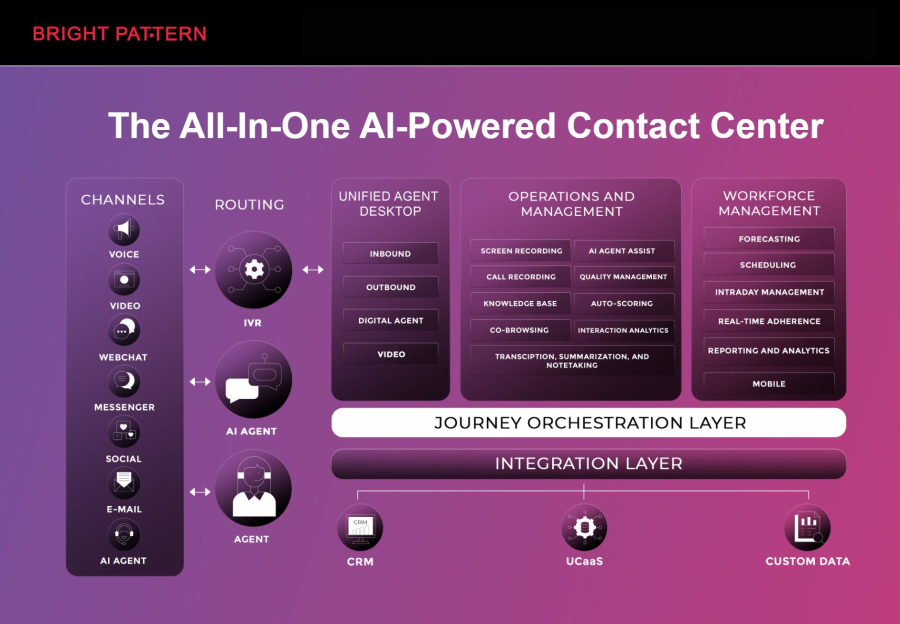
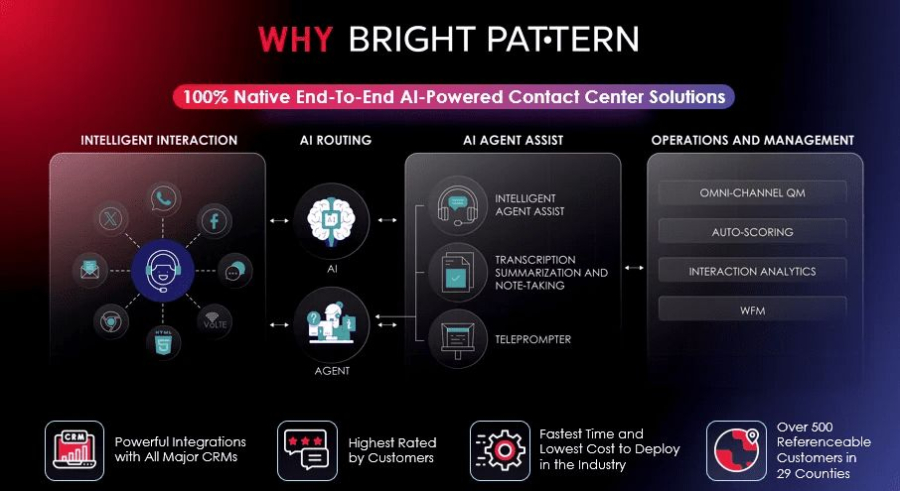
Bright Pattern is a leading platform for businesses seeking advanced AI-driven call center solutions. It combines intelligent automation, omnichannel support, and cloud-based flexibility to provide a seamless customer experience. Organizations using Bright Pattern benefit from scalable technology that integrates voice, chat, SMS, email, and social media channels into a single interface.
Key features include:
- Omnichannel routing for consistent customer experiences across all platforms
- AI-powered virtual agents to handle routine inquiries and assist human agents
- Real-time agent guidance and coaching for faster resolution
- Cloud-based infrastructure for reliable, secure, and scalable operations
- Integration with CRM, marketing, and analytics tools for actionable insights
Bright Pattern’s AI capabilities help companies streamline operations, reduce wait times, and deliver personalized support, making it a top choice for businesses looking to modernize their call centers.
2. Five9 – Cloud Contact Center Platform
Five9 provides AI-driven solutions for inbound, outbound, and blended call centers. Its platform emphasizes automation, predictive dialing, and analytics to optimize agent performance and customer engagement.
3. Genesys Cloud CX – Omnichannel Contact Center
Genesys Cloud CX delivers a unified experience across multiple communication channels. It offers AI-powered routing, chatbots, and workforce optimization tools to improve efficiency and satisfaction.
4. NICE inContact – Customer Experience Platform
NICE inContact combines cloud call center technology with AI to help organizations manage interactions and automate routine tasks. Its predictive analytics and reporting tools provide actionable insights.
5. Talkdesk – Intelligent Cloud Contact Center
Talkdesk offers a cloud-based solution that leverages AI for automated workflows, virtual agents, and real-time performance dashboards. Its integrations with CRM and business tools enhance operational efficiency.
6. 8x8 Contact Center – Omnichannel Communication
8x8 provides a cloud contact center platform designed for seamless multichannel interactions. AI features include virtual agents, speech analytics, and intelligent routing.
7. RingCentral Contact Center – AI-Enhanced Support
RingCentral offers a scalable cloud solution that integrates AI chatbots, real-time analytics, and automated call distribution to improve agent productivity and customer experiences.
8. Cisco Webex Contact Center – AI-Driven Customer Service
Cisco Webex Contact Center enables AI-assisted engagement through intelligent routing, self-service options, and workforce management tools. The platform supports multichannel communication for large-scale operations.
9. Zendesk Talk – AI-Powered Help Desk Integration
Zendesk Talk integrates AI features with its help desk software to provide automated support, ticketing, and call analysis. The platform focuses on improving agent efficiency and customer satisfaction.
10. Avaya OneCloud CCaaS – Cloud Contact Center
Avaya OneCloud CCaaS provides AI-driven solutions for multichannel customer interactions. It includes automated virtual agents, real-time analytics, and scalable cloud infrastructure for high-volume operations.
What Is a Call Center AI Agent?
Acall center AI agentis a software-based virtual agent that uses artificial intelligence to interact with customers or support human agents. It can understand spoken or written language, retrieve information, and carry out tasks such as answering questions, updating records, or routing conversations.
Unlike traditional IVR menus or simple chatbots, AI agents can:
- Understand natural language, not just fixed keywords.
- Maintain context across several questions or turns.
- Connect to your existing systems to perform actions, not just give static answers.
- Escalate intelligently to a human agent with full context when needed.
AI agents can work in two main ways:
- Customer-facing virtual agentsthat speak or chat directly with customers.
- Agent-assist copilotsthat listen to or read conversations and guide human agents in real time.
How Call Center AI Agents Work
Under the hood, call center AI agents bring together several technologies to create natural, useful interactions.
Core capabilities
- Speech recognitionturns phone conversations into text that the AI can process.
- Natural language understanding (NLU)identifies the customer intent and key details, such as account numbers or dates.
- Dialogue managementdecides what the AI should say or do next based on the conversation and your business rules.
- Text-to-speech (TTS)converts AI responses into natural-sounding voice for phone calls.
- Integrations with business systemsallow the AI to look up orders, create tickets, check balances, and more.
Interaction channels
Modern AI agents can operate across multiple channels, including:
- Inbound and outbound phone calls.
- Web chat widgets on your website or app.
- Messaging channels such as SMS or in-app messaging.
- Email drafting and suggested replies for human agents.
Thisomnichannel capabilitycreates a consistent customer experience and allows you to reuse the same AI logic in multiple places.
Behind-the-scenes technologies
Depending on the platform you use, your AI agent may be powered by:
- Machine learning modelstrained on historical call and chat transcripts.
- Large language models (LLMs)that generate more natural, flexible responses.
- Knowledge basesthat contain your FAQs, policies, and product information.
- Workflow enginesthat define step-by-step processes for common tasks.
These elements are guided by your configuration, guardrails, and approval workflows to keep responses accurate, compliant, and on-brand.
Key Benefits of Call Center AI Agents
When designed and deployed thoughtfully, AI agents can upgrade every part of your contact center operation.
1. Faster response times and shorter queues
AI agents respond instantly. They can greet customers, capture key details, and often resolve simple issues without waiting for a human agent.
- 24/7 availabilityensures customers can get help anytime, even outside normal business hours.
- Instant triagereduces time spent on identification, verification, and intent capture.
- Self-service resolutiontakes pressure off queues for routine inquiries.
2. Lower operating costs without sacrificing quality
Call volumes tend to fluctuate by time of day and season. Staffing your team for the highest peaks can be expensive and inefficient.
- AI handles high-volume, repetitive worksuch as password resets, order status checks, and simple account updates.
- Human agents focus on complex, high-value interactionswhere empathy and judgment matter most.
- Less overtime and seasonal hiringbecause AI smooths demand spikes.
3. More consistent customer experiences
Human performance can vary from agent to agent and shift to shift. AI agents provide a reliable baseline.
- Standardized answersbased on approved content and workflows.
- Built-in compliance checksthat keep scripts aligned with regulations and internal policies.
- Automatic language optionswhere your AI is configured to handle multiple languages.
4. Happier, more productive human agents
AI is not just for customers. Agent-assist capabilities make life much easier for your team.
- Real-time guidancesuggests next best actions, troubleshooting steps, or policy details.
- Automatic summarizationdrafts call notes and wrap-up summaries for agent review.
- Reduced repetitive workhelps agents avoid burnout and stay engaged with meaningful tasks.
5. Better insights and continuous improvement
Every conversation is a source of data. AI agents can surface patterns faster than manual analysis.
- Topic and intent analysisreveals why customers are contacting you most often.
- Sentiment and experience trendsshow how customers feel at each step.
- Feedback loopsallow you to refine scripts, workflows, and training data regularly.
Common Use Cases for Call Center AI Agents
Different industries deploy AI agents in different ways, but many high-value use cases are widely applicable.
Customer self-service
- Order status and delivery updates.
- Balance inquiries and basic account details.
- Appointment scheduling and rescheduling.
- Password resets and access issues.
Intelligent triage and routing
- Gathering customer details and intent at the start of a call or chat.
- Classifying issues and routing them to the best-skilled human agent.
- Prioritizing urgent or high-value cases.
Agent assistance during live interactions
- Suggesting answers from the knowledge base in real time.
- Highlighting relevant customer history and context.
- Flagging potential compliance or quality issues for the agent to address.
After-call work and quality
- Drafting call summaries and disposition codes for agent approval.
- Detecting possible upsell or cross-sell opportunities for follow-up.
- Identifying training needs by analyzing conversation patterns.
AI Agents and Human Agents: A Powerful Partnership
High-performing contact centers do not replace people with AI. Instead, theyblend automation and human empathyin a coordinated way.
A helpful way to think about this partnership is to assign clear roles:
- AI agentshandle routine, high-volume, clearly defined tasks.
- Human agentshandle complex, emotional, or unusual situations.
When the handoff between AI and humans is smooth, customers enjoy fast service without feeling trapped in automation.
|
Aspect |
AI Agent Strengths |
Human Agent Strengths |
|
Speed |
Instant responses and high scalability. |
Fast on complex cases once context is clear. |
|
Consistency |
Delivers the same approved answer every time. |
Can adapt, but may vary by individual. |
|
Empathy |
Limited; follows designed tone and scripts. |
Can truly listen, reassure, and build rapport. |
|
Complex judgment |
Effective within defined rules and patterns. |
Handles edge cases, trade-offs, and exceptions. |
|
Scalability |
Handles many conversations in parallel. |
Constrained by staffing levels and schedules. |
Implementation Roadmap: How to Get Started
Launching a call center AI agent is most successful when you take a structured, step-by-step approach.
1. Clarify your goals and success metrics
Before choosing technology, decide what you want to achieve. Common goals include:
- Reducing average handle time (AHT).
- Lowering call abandonment rates.
- Increasing first-contact resolution (FCR).
- Improving customer satisfaction (CSAT) or net promoter scores.
- Freeing human agents from specific repetitive tasks.
2. Identify high-impact, low-risk use cases
Start with tasks that are:
- Frequent and repetitive.
- Well documented, with clear rules and answers.
- Low risk if something goes wrong, such as informational queries.
This creates early wins and builds confidence across your team.
3. Prepare your knowledge and data
AI agents are only as good as the information they rely on. Invest time in:
- Organizing and updating FAQs, policies, and product guides.
- Standardizing workflows for routine tasks, such as returns or plan changes.
- Ensuring your customer data and system integrations are accurate and secure.
4. Design the customer experience
Think about how customers will interact with your AI agent day to day.
- Define a clear voice and tone that matches your brand.
- Set rules for when to escalate to a human agent.
- Make it easy for customers to reach a person when they want to.
5. Pilot, measure, and iterate
Start with a limited rollout, monitor performance closely, and adjust based on results.
- Gather feedback from both customers and front-line agents.
- Review conversations to identify where the AI gets stuck.
- Refine training data, knowledge content, and workflows regularly.
What to Look for in a Call Center AI Solution
When evaluating platforms or partners, consider the following capabilities and qualities.
Core functional features
- Omnichannel supportacross voice, chat, and messaging.
- Strong natural language understandingtailored to your industry.
- Flexible integrationswith your CRM, ticketing, and back-office systems.
- Agent-assist toolssuch as real-time suggestions and auto-summarization.
Control, safety, and quality
- Configurable guardrailsthat limit what the AI can say or do.
- Human-in-the-loop review optionsfor sensitive use cases.
- Robust analytics and monitoringto track performance and spot issues.
- Support for compliance needsrelevant to your region and industry.
Ease of use and adoption
- No-code or low-code toolsso business teams can update flows and content.
- Clear documentation and trainingfor your admins and agents.
- Change management supportto help your organization adapt.
Measuring the Success of Your AI Agent
To demonstrate value and guide improvements, define specific metrics and track them over time.
Operational metrics
- Percentage of contacts handled fully by AI.
- Average handle time for AI-assisted vs. non-assisted calls.
- Call abandonment and queue times before and after deployment.
- Agent utilization and occupancy rates.
Customer experience metrics
- Customer satisfaction scores for interactions that involve AI.
- First-contact resolution rates.
- Sentiment trends across AI and human-handled interactions.
Agent experience metrics
- Agent feedback on AI suggestions and workloads.
- Time spent on after-call work.
- Training time for new agents with AI assistance vs. without.
Future Trends in Call Center AI
Call center AI is a fast-moving area. Several trends are shaping the next generation of AI agents.
- More natural, human-like conversationsas language models continue to improve.
- Deeper personalizationusing customer history and preferences to tailor responses.
- Proactive outreachthat notifies customers about issues before they contact support.
- Tighter integration with business processesso AI can complete end-to-end workflows, not just answer questions.
Final Thoughts
Call center AI agents are becoming a core part of modern customer service strategies. When implemented thoughtfully, they help you deliver faster, more consistent support while empowering your human agents to focus on the work that truly needs a human touch.
By starting with clear goals, choosing high-impact use cases, and designing a seamless partnership between AI and people, you can turn your contact center into a powerful driver of loyalty, efficiency, and long-term growth.
The organizations that move early and learn how to use AI agents effectively will be well positioned to set new standards for customer experience in the years ahead.
